Sunday, February 21, 2021

A simulation-based valuation of ViacomCBS Inc. (VIAC): February 2020


Summary

- ViacomCBS (VIAC) is a multinational mass media conglomerate headquartered in New York City. It was formed as a result of the merger of CBS Corporation and Viacom in late 2019 ().

- In this post we provide a simulation-based (sim-based) valuation () of VIAC.

- We set our sim-based estimated earnings growth rate for the next 5 years to be 30%. This is approximately twice the consensus among sell-side analysts, which we see as conservative.

- Our results suggest the following fair values – stock price: $69.76, and price-to-earnings ratio: 32.45.

- VIAC trades at about $62.69 at the time of this writing, so it appears to be undervalued, with a potential upside of a little more than 11.27%.

- If earnings growth rate for the next 5 years turns out to be 35% (instead of the 30% we used), our simulation suggests the following fair values – stock price: $89.09, and price-to-earnings ratio: 41.44.

ViacomCBS (VIAC)

ViacomCBS is a multinational mass media conglomerate headquartered in New York City (). It was formed as a result of the merger of CBS Corporation and Viacom in late 2019. The company owns, among other highly valuable properties, the film studio Paramount Pictures, CBS Television Studios, CBS Television Stations, MTV, Nickelodeon, BET, Comedy Central, and Showtime. Valuable sports rights owned include the NFL, the NCAA's March Madness, and college football.

Estimating a fair value for the stock

In this post we provide a simulation-based (sim-based) valuation () of VIAC.

At the time of this writing the company had a trailing twelve months price-to-earnings ratio of 29.16. The trailing twelve months price-to-cash flow ratio was 13.60. Earnings growth trends have been remarkably positive recently. We will set our sim-based estimated earnings growth rate for the next 5 years to be 30%. This is approximately twice the consensus among sell-side analysts, which we see as conservative.

The table below summarize our sim-based results.
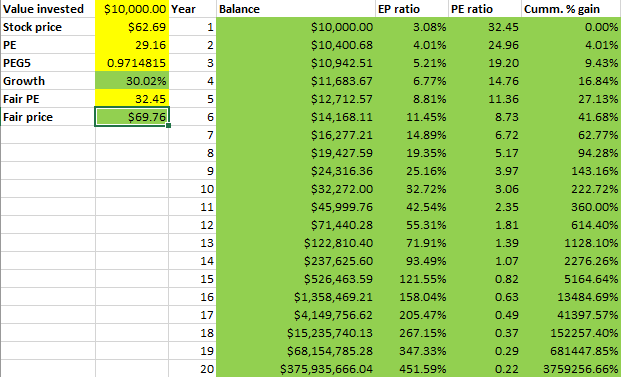


Since our sim-based analysis uses a S&P 500 return as a basis, our results summarized on the table above suggest the following fair values – stock price: $69.76, and price-to-earnings ratio: 32.45. VIAC trades at about $62.69 at the time of this writing, so it appears to be undervalued, with a potential upside of a little more than 11.27%.

Final thoughts

Discovery, Inc. (DISCA), which will soon report earnings, is very similar to VIAC in terms of balance sheet and growth prospects. Nevertheless, DISCA’s price-to-sales ratio is about twice the one for VIAC.

One could argue that sell-side analysts are underestimating the potential impact on earnings of the COVID reopening with respect to the NFL, the NCAA's March Madness, and college football. If earnings growth rate for the next 5 years turns out to be 35% (instead of the 30% we used), our simulation suggests the following fair values – stock price: $89.09, and price-to-earnings ratio: 41.44.

Disclosure

The author owns VIAC shares at the time of this writing.

Thursday, January 21, 2021

Reflation or inflation? A look at 12-month commodity trends in January 2021


Summary

- The term “reflation” is used in this post to refer to an increase in certain commodity prices due to the expectation of increased economic activity.

- The term “inflation” refers to an increase in certain commodity prices due to currency devaluation.

- When we look at the past 12-month period, copper has been increasingly outperforming silver, and silver outperforming gold.

- The patterns above suggest reflation, which is generally bullish for equities going forward.

Reflation versus inflation

The term “reflation” is used in this post to refer to an increase in certain commodity prices due to the expectation of increased economic activity. The term “inflation” refers to an increase in certain commodity prices due to currency devaluation. Generally speaking, reflation would be bullish for equities, and inflation would not.

12-month commodity trends: Copper, silver, and gold

A sign of reflation would be a 12-month trend characterized by copper outperforming silver, and silver outperforming gold – in terms of price. Inflation, on the other hand, would be characterized by gold outperforming silver, and silver outperforming copper.

The figure below shows the past 12-month performances, in terms of price increases, for the following commodity funds: SPDR Gold Shares (GLD), iShares Silver Trust (SLV), and United States Copper Index Fund, LP (CPER). The performances are measured by percentage increases in prices for the past 12 months, 6 months, and 3 months.


As you can see, the trend for the past 12 months has been one of copper increasingly outperforming silver, and silver outperforming gold. Silver has actually done better than copper when we consider the entire 12-month period, but copper has been significantly outperforming silver more recently – in the past 6 and 3 months.

The patterns above suggest reflation, which is generally bullish for equities going forward. These patterns are particularly bullish for “banks and tanks” equities, and also for commodities in general – more so for commodities that have an industrial use.

Wednesday, December 9, 2020

A simulation-based valuation of Alliance Data Systems Corporation (ADS): December 2020


Summary

- Alliance Data Systems Corporation (ADS) is a marketing and loyalty programs provider headquartered in Columbus, Ohio ().

- In this post we provide a simulation-based (sim-based) valuation () of ADS.

- Our results suggest the following fair values – stock price: $156.13, and price-to-earnings ratio: 18.16.

- ADS trades at $77 at the time of this writing, so it appears to be undervalued, with a potential upside of a little more than 100%.

Alliance Data Systems Corporation (ADS)

Alliance Data Systems Corporation (ADS) is a marketing and loyalty programs provider headquartered in Columbus, Ohio. Among other things, the company provides private label credit and debit cards, which allows them to also add value to their clients by developing and executing data-driven marketing initiatives. Recently ADS announced the upcoming acquisition of Bread, a digital payments company.

The company operates in two main segments: Card Services and LoyaltyOne. Card Services makes up about 80% of the company’s revenues; it involves transaction processing and customer collections services. LoyaltyOne generates approximately 20% of the revenues, and involves data-driven marketing initiatives. Financial services providers, grocers, drug stores, and specialty retailers are among the company’s main clients.

Estimating a fair value for the stock

In this post we provide a simulation-based (sim-based) valuation () of ADS.

At the time of this writing the company had a trailing twelve months price-to-earnings ratio of 11.63. The trailing twelve months price-to-cash flow ratio was 5.57. Earnings growth trends have been remarkably positive recently. We will set our sim-based estimated earnings growth rate for the next 5 years to be the group average, at 18.39% - to be somewhat conservative.

The table below summarize our sim-based results.


Since our sim-based analysis uses a S&P 500 return as a basis, our results summarized on the table above suggest the following fair values – stock price: $156.13, and price-to-earnings ratio: 18.16. ADS trades at about $77 at the time of this writing, so it appears to be undervalued, with a potential upside of a little more than 100%.

Final thoughts

Like many companies that extend credit to customers (e.g., car and equipment manufacturers), ADS is often presented as having a very high debt load. This can be misleading, because the company does not have to pay interest on debt that others owe to it. In fact, this type of debt generates a significant amount of interest income. The problem is the risk of default, which is countered by data-driven credit analyses prior to lending approval.

The expectation of growth in the short term is way above the group average of 18.39%. Still, the company is currently valued as if there will be little to no growth going forward. The reason for this is that some of the retailers that ADS works with are having serious problems, even though ADS also has partnerships with retailers that are doing quite well. With the synergistic acquisition of Bread, it is quite possible that ADS will experience above-average growth in the next 5 years.

Disclosure

The author owns ADS shares at the time of this writing.

Friday, November 13, 2020

Understanding the price of bitcoin: Data from early 2019 to mid-2020


Summary

- We conducted a multivariate analysis of the price of bitcoin with financial data from early 2019 to mid-2020.

- Our main conclusion is that bitcoin should do well in what we could call a “nervous bull market”.

- In this scenario, we would see the market generally going up, with some expectation of inflation in the future, all of this against a bearish backdrop.

The analysis

We used WarpPLS () to create several second-order indices (as composites of first-order index funds) and link them in an exploratory model to help us understand what has been driving the price of bitcoin from early 2019 to mid-2020.

The period from early 2019 to mid-2020 was used because prior to it bitcoin was generally perceived as a cash-like currency that could be used for day-to-day transactions among individuals and organizations. From early 2019 onwards, the perception shifted to one of a store of value; something akin to “digital gold”.

We collected and analyzed daily data from various funds. More specifically, the price of one share of each fund at each day’s close was used. In terms of WarpPLS settings, the outer model analysis algorithm used was “PLS Regression”, and the default inner model analysis algorithm was “Linear”. The composite variables were made up of the following funds.

- FIN, reflecting a bullish view of financial institutions, was made up of the iShares U.S. Regional Banks ETF (IAT), and the Financial Select Sector SPDR Fund (XLF).

- HDG, reflecting a bearish view of the market (intention to hedge), was made up of the iShares Silver Trust (SLV), the SPDR Gold Shares (GLD), and the iShares 20+ Year Treasury Bond ETF (TLT).

- MKT, reflecting a bullish view of the market, was made up of the SPDR S&P 500 ETF Trust (SPY), and the Invesco QQQ Trust (QQQ).

- GBTC, reflecting the price of bitcoin, was measured through a single indicator, namely the Grayscale Bitcoin Trust (GBTC).

The Grayscale Bitcoin Trust (GBTC) provides one of the most straightforward ways for investors to own bitcoin. It is generally available to retail investors through various online brokers.

The results

The figure below shows our model with the main results. The iGBTC variable is an instrumental variable that controls for the effect of “time” on the results; to account for autoregression, or the fact that the variable GBTC is influenced by its own values back in time. The instrument used was a numeric variable generated based on the date associated with each data point. In a previous analysis published on this blog, based on the same data, we did not employ this type of control, which led to slightly different results.


The path coefficients (indicated as beta coefficients) reflect the strength of the relationships; they are a bit like standard univariate (or Pearson) correlation coefficients, except that they take into consideration multivariate relationships (they control for competing effects). A positive beta means that an increase in a variable is associated with an increase in the variable that it points to.

The P values indicate the statistical significance of the relationship; a P lower than 0.05 means a significant relationship (95 percent or higher likelihood that the relationship is “real”). The R-squared value reflects the percentage of explained variance for the variable in question; the higher it is, the better the model fit with the data.

I should note that the P values have been calculated using a nonparametric technique, which does not require the assumption that the data is normally distributed to be met. This is good, because I checked the data, and it does not look like it is normally distributed. 

So, what does the model above tell us? It tells us that: 

- As a bullish view of financial institutions (FIN) increases, the price of bitcoin (GBTC) also increases, in a statistically significant way (beta=0.13; P below .01). This is not normally what one would expect, if we assume that bitcoin’s success means the failure of financial institutions.

- As a bearish view of the market (HDG) increases, the price of bitcoin (GBTC) also increases, in a statistically significant way (beta=0.42; P below .01). This is what one would expect, if we assume that bitcoin is used as a hedge against a drop in the market. Note that this effect is the strongest in the model, by far.

- As a bullish view of the market (MKT) increases, the price of bitcoin (GBTC) also increases, in a statistically significant way (beta=0.17; P below .01). Again, this is not normally what one would expect, if we assume that bitcoin’s success means that a bear market is under way.

The three predictors above (i.e., FIN, HDG, and MKT) explain 33 percent of the variance in the variable GBTC (R-squared=0.33). This essentially means that the model is incomplete, although it does explain enough of the variance in GBTC to be useful in an exploration of major influences on the price of bitcoin.

Main conclusion

While the results above may look contradictory, they in fact suggest that bitcoin should do well in what we could call a “nervous bull market”. Here we would see the market generally going up, with some expectation of inflation in the future (which tends to be good for financials), all of this against a generally bearish backdrop.

Disclosure

The author does not own bitcoin at the time of this writing.

Sunday, October 11, 2020

Does yield curve flattening hurt US bank stocks?


Summary

- US banks derive part of their income from borrowing funds and investing them, with interest rates paid and earned being correlated with the short and long ends of the Treasuries yield curve.

- Since the short end yields (for Treasuries) tend to be lower than the long end yields, usually US banks benefit financially from the difference.

- Given this, one would expect bank stocks to be strongly and positively correlated with yield curve steepening; i.e., the opposite of flattening.

- If we look at data from the past 5 years, however, the opposite has happened. As the yield curve has flattened, bank stocks have gone up.

Yield curve flattening and US bank stocks

US banks derive part of their income from borrowing funds and investing them, with interest rates paid and earned by the banks being correlated with the short and long end of the yield curve. Since the short end yields (for Treasuries) tend to be lower than the long end yields, usually US banks benefit from the difference. Given this, one would expect bank stocks to be strongly and positively correlated with yield curve steepening; i.e., the opposite of flattening.

The figure below shows, at the top, the difference in yields for 10-year and 3-month Treasuries for the past 5 years. The two graphs at the bottom show the stock prices for two banks: JPMorgan Chase, representing multinational investment banks; and U.S. Bancorp, representing regional banks. The sources for the graphs are Yahoo Finance and the US Federal Reserve Economic Data (FRED) (, ).


As you can see, prior to COVID there seems indeed to be a correlation between US bank stocks and yield curve flattening. However, it is the opposite of what we would expect. The correlation is negative. As the curve flattens, bank stocks go up. In other words, US banks tend to do well in response to what could be seen as a major obstacle to profitability.

What is happening? Compensatory adaptation

As the yield curve flattens, US banks react in a compensatory way – e.g., by resorting to other sources of income. This is compensatory adaption theory at work (, ).

Compensatory adaptation of this type is facilitated by the size and flexibility of the US economy. This makes the environment in which US banks operate significantly different from those of Japan and Europe, where arguably banks have fared worse.

Sunday, September 13, 2020

Cold weather and COVID: Compensatory adaptation may lead to unexpected results


Summary

- If COVID cases necessarily spike in cold weather, it would be reasonable to expect more lockdowns in countries, like the US, which are about to transition from warm to cold weather.

- These lockdowns would presumably have a negative economic effect, and likely a severe negative effect on equity prices.

- This post looks at data from Brazil and the US, and concludes that COVID infections may not be significantly influenced by the weather.

- The reason may be a compensatory adaption feedback loop – people adapt in a compensatory way.

- In fact, if compensatory adaptation theory is any guide, it would not be surprising to see COVID infections actually go down, as a country with growing COVID infections transitions from warm to cold weather.

Do COVID cases spike in cold weather?

If COVID cases necessarily spike in cold weather, it would be reasonable to expect more lockdowns in countries, like the US, which are about to transition from warm to cold weather. These lockdowns would have a negative economic effect, and likely a severe negative effect on equity prices. But is it inevitable that COVID cases spike in cold weather?

To answer this question, it may be instructive to look at COVID figures for Brazil and the US, because these two countries have had similar responses to the pandemic (); and have opposite weather patterns – when it is hot in the US, it is cold in Brazil, and vice-versa. This applies particularly to the most populous areas of the two countries.

COVID figures for Brazil and the US

At the time of this writing, we had the following approximate numbers for Brazil and the US. Brazil – population: 209.5 million, COVID cases: 4.12 million, and COVID deaths: 126 thousand. US – population: 328.2 million, COVID cases: 6.26 million, and COVID deaths: 188 thousand. The two graphs below show the two following ratios: cases-to-population, and deaths-to-population.


The ratios are too close to support the “spike hypothesis”

In the last several months since the pandemic hit both countries, it has been generally cold in Brazil and hot in the US. Given this, these ratios are too close to support the assumption that COVID cases spike in cold weather. So, what would be a reasonable answer to the question posed earlier: do COVID cases spike in cold weather? The answer is: probably not.

What is happening? Compensatory adaptation

This brings to mind another question: would indoor activities, such as restaurant dining and movie theater attendance, lead to spikes in COVID cases?

Well, the idea was that cold weather would lead to more indoor activities ...

While risk of infection may go up with cold weather and more indoor activities, people react in a compensatory way – e.g., by wearing masks, resorting to social distancing etc. This is compensatory adaption theory at work (,). This feedback loop may lead to unexpected results.

If we use compensatory adaptation theory as a guide here, it would not be surprising if COVID infections were to go down, as a country with growing COVID infections transitions from warm to cold weather.

Sunday, August 23, 2020

Interest rates and PE ratio expansion: S&P 500 going above 4100 before the end of 2020?


Summary

- Most professional investors see price/earnings (PE) ratios as inversely proportional to interest rates.

- Mathematically, this would be expressed as: PE = k / IR.

- Assuming that the interest rate on 10-year Treasuries could rise to 1%, and the k multiplier to rise to the pre-COVID level of 0.39, the expected S&P 500 PE ratio would then be 38.66.

- This would bring the S&P 500 up to 4,148. Still, not as expensive, in PE ratio terms, as in either the 2000s dot-com bubble or the Great Recession.

Interest rates and PE ratios

Most professional investors, including the late Benjamin Graham (), see PE ratios as inversely proportional to interest rates for Treasuries. Mathematically, this would be expressed as follows, where PE = the PE ratio of an equity security, IR = a relevant interest rate, and k = a multiplier.

PE = k / IR

There are a couple of key reasons for this relationship. One is that Treasuries become less attractive as an investment when interest rates go down. Since the Treasuries market is very large, a little over $21 trillion at the time of this writing, even a fraction of it moving to equities would push their PE ratios up significant.

Another key reason for the relationship above is that investing in Treasuries when interest rates are low becomes risky in terms of principal preservation. Treasury prices are inversely related to the interest they pay, or their yields. When yields are very low, the tendency is for them to go up.

Interest rates on 10-year Treasuries

The figure below shows the interest rates for the 10-year Treasury notes from January 2007 to July 2020. Those rates, which influence a number of other consumer-relevant rates (e.g., those for mortgages), go from 4.76% to 0.55% during the period.


While the interest rates have been going down over the years, they went up significantly during the recovery from the Great Recession. The same may happen during the recovery from the COVID recession. A move from 0.55% to 1% would be significant.

S&P 500 PE ratios

The figure below shows the PE ratios for the S&P 500 from January 2007 to July 2020. Note that the PE ratio for July 2020 is nowhere near the peak during the Great Recession.


The k multipliers

Finally, the figure below shows the k multipliers for the relationship between the S&P 500 PE ratios and interest rates on 10-year Treasuries from January 2007 to July 2020. An all-time low was reached for the multiplier in July 2020.


In a low interest rate environment, a high k multiplier would typically be associated with a high PE ratio. The multiplier increase, if it happens, should lag the interest rate reduction. Investors need time to be convinced that interest rates will remain subdued. 

S&P 500 above 4,100 soon?

Assuming that the interest rate on 10-year Treasuries could rise to 1%, and the k multiplier to rise to the pre-COVID level of 0.39 (which is below its historical average), the expected S&P 500 PE ratio would then be 38.66. This would bring the S&P 500 up to 4,148. Still, not as expensive, in PE ratio terms, as in either the 2000s dot-com bubble or the Great Recession.

This PE ratio expansion for the S&P 500 is already happening at the time of this writing, with the S&P 500 hitting an all-time high. Our main point in this post is that, if interest rates on Treasuries remain low, we may see more of that - even with bankruptcies among small businesses, significant  unemployment, and high volatility (including downward corrections).